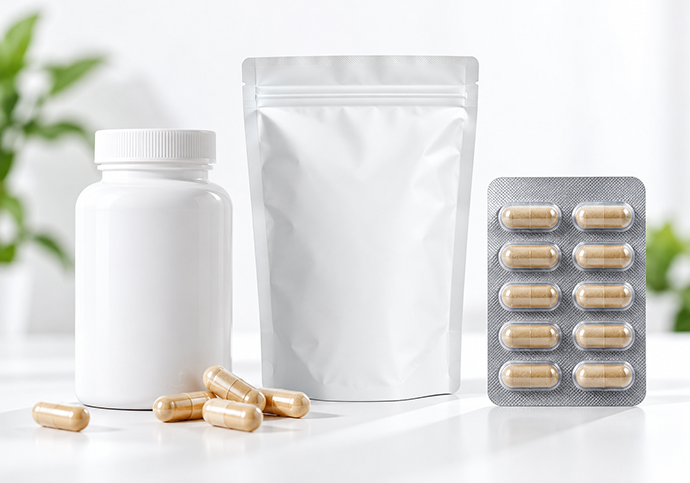
Supplement Packaging Compared: Bottle vs. Pouch vs. Blister — Cost, Barrier, and MOQ
Packaging is usually treated as the last decision in a supplement project. It should be one of the first, because it does three things simultaneously: it protects the product, it sets a floor under your order quantity, and it determines how the product is perceived on shelf or in an unboxing.
It is also the most common hidden constraint in a launch. As covered in our 🔗[[supplement MOQ guide]], the print minimum on a custom carton can exceed the product minimum — meaning packaging, not manufacturing, decides how much you must buy.
The Options at a Glance
| Bottle | Pouch | Blister | Stick Pack | |
|---|---|---|---|---|
| Typical material | HDPE, PET, glass | Multi-layer laminate | PVC/PVDC, aluminium | Laminate film |
| Barrier | Good; enhanced with desiccant and seal | Good–very good | Excellent per cavity | Very good per unit |
| Unit cost | Moderate | Low–moderate | Higher per unit | Moderate |
| Tooling | Low with stock bottles | Low with stock sizes | Higher | Moderate |
| Typical MOQ driver | Closure and label | Print run | Tooling + machine setup | Print + filling setup |
| Best for | Broadest default | Powders, e-commerce | Adherence, moisture-sensitive | Powders, on-the-go |
Why Barrier Is the Real Selection Criterion
Cost gets the attention, but barrier is what protects your shelf life. The three enemies are moisture, oxygen, and light.
- Moisture drives hydrolysis, caking, microbial growth, and potency loss. Hygroscopic powders and gummies are especially exposed.
- Oxygen drives oxidation — the dominant failure mode for omega-3 oils and other unsaturated actives.
- Light degrades photosensitive actives, including several vitamins and menaquinones.
Barrier performance is quantified rather than guessed: WVTR (water vapour transmission rate) and OTR (oxygen transmission rate) are the numbers to request from your packaging supplier, and they should be matched to your product's sensitivity. Material and seal-integrity choices are explored in detail in packaging references such as 🔗[[supplement moisture barrier and seal integrity comparisons]].
Practical enhancers, in order of cost-effectiveness:
- Induction seal on the bottle — the single cheapest barrier upgrade.
- Desiccant — essential for hygroscopic powders.
- Higher-barrier material — amber glass, or barrier laminates for pouches and blisters.
- Oxygen scavenger — for oxidation-sensitive actives.
Cost: More Than Unit Price
| Cost Element | Bottle | Pouch | Blister |
|---|---|---|---|
| Component unit cost | Moderate | Low | Higher |
| Tooling / moulds | Low if stock | Low if stock | Higher |
| Print minimums | Labels low; cartons higher | Moderate | Moderate–high |
| Filling equipment | Standard, widely available | Form-fill-seal required | Dedicated blister line |
| Freight efficiency | Bulky — more air shipped | Excellent cube efficiency | Good cube efficiency |
| Damage in transit | Glass risk; plastic low | Low | Low |
Two cost effects are consistently underestimated:
- Freight cube. Bottles ship air. Pouches and blisters pack densely, which can offset a higher unit cost at volume — a real factor in the overall stack described in our 🔗[[manufacturing cost breakdown]].
- Equipment availability. Not every plant runs every format. Choosing a format your manufacturer does not run adds a subcontractor, a transfer step, and time — see our 🔗[[lead times guide]].
MOQ and Launch Flexibility
This is where the decision bites for smaller brands:
- Bottles with stock components and custom labels are the lowest-barrier entry. They avoid mould tooling and keep print minimums small.
- Pouches are flexible when using stock sizes and standard print, and increasingly available through e-commerce-oriented lines.
- Blisters typically require tooling and a dedicated blister line, so minimums and setup costs sit higher.
- Custom bottles, closures, or cartons reset the whole equation — tooling plus print minimums.
If your effective minimum is the problem, changing packaging is usually a faster fix than renegotiating the product MOQ.
Channel and Consumer Fit
- Blister — supports adherence (visible daily doses), travel-friendly, strong barrier per dose; common in European pharmacy and for moisture-sensitive products.
- Bottle — the default for North America; familiar, easy to count, simple to label, wide closure options including child-resistant.
- Pouch — light, low material use, strong e-commerce economics; weaker premium perception for some categories.
- Glass bottle — premium perception and excellent barrier, at higher weight, freight cost, and breakage risk.
Child-resistant closures are mandatory in several jurisdictions for certain product types — a regulatory requirement, not a preference.
Sustainability
- Pouches use the least material and ship efficiently, but multi-layer laminates are difficult to recycle.
- HDPE and PET bottles are widely accepted in curbside recycling — the strongest recycling story currently available at scale.
- Blisters are typically multi-material and hard to recycle, though mono-material options are emerging.
- Glass is readily recycled but heavy, with a higher transport footprint.
Sustainability claims must be specific and substantiated; "eco-friendly" without evidence is a claim risk under the frameworks in our 🔗[[label claims compliance guide]].
What to Specify and Validate
- Material and barrier data— request WVTR and OTR figures
- Closure specification— type, torque range, child-resistant if required
- Seal integrity— induction seal specification and seal-integrity testing
- Light protection— amber or opaque where the active requires it
- Desiccant and oxygen scavengerwhere justified
- Print and label durability— adhesion, scuff resistance
- Transit validation— drop, vibration, and temperature/humidity exposure
- Stability in the final pack— shelf life must be demonstrated in the pack you actually ship
That last point matters: stability is a property of product plus packaging. A date established in one pack does not automatically transfer to another, as explained in our 🔗[[stability testing guide]].
Decision Framework
Choose a bottle when:
- You want the lowest-friction, most widely available option.
- The formula is not highly moisture-sensitive, or desiccant and induction seal are sufficient.
- You need child-resistant options and simple labelling.
Choose a pouch when:
- The product is a powder and e-commerce is the main channel.
- Freight cube and material use matter to your cost or sustainability story.
- You can use stock sizes to keep minimums low.
Choose a blister when:
- Moisture sensitivity is high and per-dose protection is valuable.
- Adherence and dose visibility are part of the value proposition.
- The channel is pharmacy or European retail where blisters are the norm.
Choose a stick pack when:
- Convenience and portability are the core proposition.
- The dose is small and the format supports the positioning.
FAQ
Which packaging is cheapest for supplements?
Unit cost is usually lowest for pouches and highest for blisters, but total cost depends on tooling, print minimums, filling equipment, and freight cube. Compare landed, filled cost — not component price alone.
Does packaging affect shelf life?
Yes, substantially. Moisture, oxygen, and light transmission determine how fast potency declines. Shelf life must be demonstrated in the actual shipping pack.
Why is my MOQ so high if the product is simple?
Often because of packaging — custom carton print runs or closure minimums rather than the product itself. Stock components with custom labels usually fix it.
Are blisters better than bottles?
Better per-dose barrier and adherence support; higher unit cost and tooling. It depends on the product's sensitivity and the channel.
Can I change packaging after launch?
Yes, but treat it as a change requiring stability confirmation, seal-integrity validation, and usually a label artwork update.
Conclusion
Packaging is where protection, cost, minimum order, and channel fit intersect. Select on barrier first, then cost, then minimums — and validate shelf life in the pack you actually ship. If your MOQ is the blocker, packaging is usually the fastest lever you have.
At JHD GLOBAL, we support all major primary formats with stock and custom options, barrier-matched to your formula, with seal-integrity and transit validation.
Discuss packaging options for your formula: sales@ingredientssupply.com