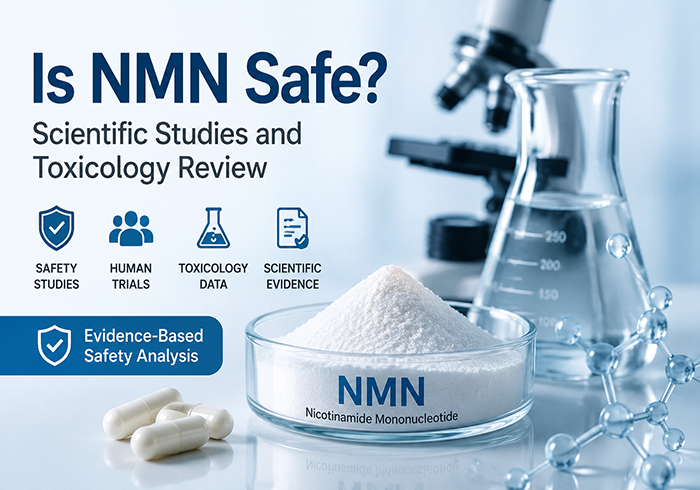
Is NMN Safe? Scientific Studies and Toxicology Review
Publish Date: 2026-07-14 10:43:36 Views: 236
As NMN supplements become increasingly popular, one of the most important questions consumers and manufacturers ask is:
Is NMN safe for long-term use?
While NMN has demonstrated potential benefits in preclinical studies, understanding its safety profile requires examining toxicology research, animal studies, and human clinical trials.
Current evidence suggests that NMN has a favorable safety profile when used at studied doses. However, researchers continue to investigate its long-term effects, optimal dosage, and safety across different populations.
What Is NMN and Why Does Safety Matter?
NMN (Nicotinamide Mononucleotide) is a naturally occurring nucleotide derived from vitamin B3 (niacin). It serves as a direct precursor of NAD+ (nicotinamide adenine dinucleotide), a critical molecule involved in:
Cellular energy production
Mitochondrial function
DNA repair pathways
Regulation of metabolic processes
NAD+ levels naturally decline with age, which has led researchers to investigate whether NMN supplementation can help restore NAD+ availability.
However, increasing NAD+ metabolism raises important safety questions:
Can excessive NMN intake disrupt normal metabolism?
Does long-term NAD+ elevation cause unwanted effects?
Is NMN safe at higher supplemental doses?
To answer these questions, researchers have conducted toxicology studies and controlled human trials.
Toxicology Studies: Evaluating NMN Safety at High Doses
Before testing supplements in humans, toxicological studies evaluate whether a compound causes harmful effects at different exposure levels.
Animal Toxicology Research
Preclinical studies have investigated NMN safety using repeated oral administration models.
Research has examined:
General toxicity
Organ function
Blood biomarkers
Metabolic changes
Potential genetic toxicity
Available toxicology data indicate that NMN does not demonstrate significant toxicity under studied conditions.
One important finding from safety evaluations is that NMN did not show mutagenic activity in standard laboratory testing, suggesting it does not appear to damage genetic material under experimental conditions.
Researchers have also identified high tolerated doses in animal studies, providing a safety foundation before human trials.
However, animal studies cannot fully predict long-term human outcomes, making clinical research essential.
Human Clinical Trials: What Do Studies Show About NMN Safety?
Human studies provide the most relevant evidence for evaluating NMN safety.
Although clinical research is still developing, multiple trials have investigated NMN supplementation in healthy adults.
Single-Dose Safety Studies
Early human research evaluated whether single NMN doses could cause immediate adverse effects.
In one clinical study involving healthy Japanese men, participants received NMN doses of:
100 mg
250 mg
500 mg
Researchers monitored:
Heart rate
Blood pressure
Body temperature
Oxygen saturation
Physical symptoms
The study found no significant safety concerns or clinically meaningful changes after NMN intake.
Repeated Daily NMN Supplementation Studies
A randomized, double-blind, placebo-controlled study evaluated daily NMN supplementation in healthy adults.
Participants received:
1250 mg NMN per day for 4 weeks
Researchers analyzed:
Blood parameters
Liver and kidney biomarkers
Urine analysis
Body composition
Physical measurements
The results showed:
No serious adverse events
No clinically significant abnormal changes
Good tolerance among participants
The researchers concluded that daily oral NMN supplementation at 1250 mg for four weeks was safe and well tolerated in healthy adults.
Longer-Term Human Studies
Longer supplementation periods have also been evaluated.
A 12-week randomized controlled trial studied healthy middle-aged adults taking:
250 mg NMN per day
The study reported:
Increased NAD+ metabolite levels
No significant safety concerns
No adverse events related to NMN supplementation
These findings suggest that moderate-dose NMN supplementation can be tolerated over several months.
Current clinical trials have reported relatively few adverse effects.
Some participants have experienced mild symptoms, including:
Digestive discomfort
Headache
Temporary fatigue
Changes in sleep patterns
However, these effects have not consistently been linked directly to NMN, and larger studies are needed to determine whether they represent true NMN-related reactions.
Compared with many bioactive compounds, NMN has demonstrated a relatively strong safety profile in early human research.
Regulatory Status of NMN
The regulatory status of NMN differs between countries and regions.
United States
In the United States, NMN has been marketed as a dietary supplement ingredient, although regulatory discussions regarding its classification continue.
Europe
European authorities have evaluated NMN under the Novel Food framework.
Recent safety assessments have reviewed available toxicology and human intervention data, noting that current studies did not identify adverse effects associated with highly purified NMN under investigated conditions.
Global Perspective
Because NMN is a relatively new supplement category, regulatory approaches continue to evolve as additional scientific evidence becomes available.
Is NMN Safe for Long-Term Use?
Based on current evidence:
Current Research Supports:
✔ Good short-term safety profile ✔ No major toxicity signals identified ✔ Positive tolerance in human trials ✔ No significant changes in standard safety biomarkers
However, some limitations remain:
Human studies are still relatively small
Most trials last weeks or months rather than years
Effects in specific groups require further investigation
Long-term NMN safety research is ongoing, particularly regarding:
Chronic daily supplementation
Older populations
Individuals with metabolic conditions
Combination use with other supplements
Safety Summary: What Does Science Say About NMN?
Based on available toxicology research and human clinical studies:
Safety Area
Current Evidence
Acute toxicity
No significant concerns identified
Genetic toxicity
No mutagenic effects observed in testing
Human tolerance
Generally well tolerated
High-dose studies
Up to 1250–1500 mg/day studied short term
Long-term safety
Requires additional research
Overall, current scientific evidence suggests that NMN appears to have a favorable safety profile when consumed at studied doses. However, as with any nutritional supplement, product quality, dosage, and individual health conditions should be considered.
Future large-scale and long-duration clinical trials will provide further insights into the role of NMN as a long-term NAD+ support supplement.
Frequently Asked Questions About NMN Safety
Is NMN safe every day?
Current clinical trials suggest that daily NMN supplementation is well tolerated for periods ranging from several weeks to several months. More long-term research is needed.
Can NMN cause toxicity?
Available toxicology studies have not shown significant toxicity at studied doses. However, extremely high doses beyond research levels have not been fully evaluated.
Human studies have investigated a wide range of doses, including 250 mg/day, 500 mg/day, 1250 mg/day, and higher short-term doses.
The optimal long-term dosage remains under investigation.
Is NMN safe for everyone?
Most studies have involved healthy adults. Pregnant individuals, people with chronic medical conditions, or those taking medications should consult healthcare professionals before starting NMN supplementation.
We use cookies to enhance your browsing experience, serve personalized content and analyze our traffic. By clicking "Accept All", you consent to our use of cookies.