How to Choose the Right Supplement Contract Manufacturer: The Complete OEM/ODM Guide
The global dietary supplement contract manufacturing market is booming — valued at an estimated USD 59.63 billion in 2024 and projected to grow at a robust CAGR through 2030 (Grand View Research). Behind this growth is a simple reality: building a supplement brand no longer requires owning a manufacturing facility. Instead, brands of every size — from first-time entrepreneurs to established wellness companies — rely on supplement contract manufacturers to turn their formulas into market-ready products.
But this convenience comes with a critical challenge: choosing the wrong manufacturer can mean regulatory violations, product recalls, quality inconsistencies, and brand reputation damage that is nearly impossible to recover from. The right partner, on the other hand, becomes a strategic extension of your business, providing the technical expertise, regulatory compliance, and production capacity to scale your brand.
This comprehensive guide walks you through everything you need to know about supplement contract manufacturing — the different business models (OEM vs ODM vs private label), the end-to-end manufacturing process, the regulatory landscape, and a practical framework for selecting the right manufacturing partner.
Understanding the Supplement Manufacturing Landscape: OEM vs ODM vs Private Label
Before you can select a manufacturer, you need to understand the different service models available — each represents a different division of responsibility between you and the manufacturer.
OEM (Original Equipment Manufacturing)
Definition: You provide the complete product specification — the formula, ingredients, dosage form, and packaging design — and the manufacturer produces it to your exact specifications.
| Aspect | Details |
|---|---|
| Who owns the formula? | You (the brand) |
| Customization level | Highest — full control over formulation |
| Time to market | Longer (formula development required) |
| Cost | Higher (custom formulation, smaller initial runs) |
| Best for | Established brands with proprietary formulas, brands seeking differentiation |
ODM (Original Design Manufacturing)
Definition: The manufacturer offers pre-developed, ready-to-produce formulas that you can customize with your branding. You select from their catalog of proven formulations rather than developing your own.
| Aspect | Details |
|---|---|
| Who owns the formula? | The manufacturer (or shared, depending on agreement) |
| Customization level | Medium — customization limited to packaging and minor tweaks |
| Time to market | Faster (formulas already validated) |
| Cost | Lower (economies of scale on existing formulas) |
| Best for | New brands, fast market entry, lower capital requirements |
Private Label / White Label
Definition: The manufacturer produces generic, ready-made products that you simply apply your label to. Minimal to no customization.
| Aspect | Details |
|---|---|
| Who owns the formula? | The manufacturer |
| Customization level | Lowest — label only |
| Time to market | Fastest |
| Cost | Lowest |
| Best for | Retailers, influencers testing the market, quick brand launch |
Toll Manufacturing
Definition: You supply all raw materials and the manufacturer only provides the processing/production service (mixing, encapsulation, packaging). Also called "contract processing."
| Aspect | Details |
|---|---|
| Who owns the formula? | You (brand) — plus you own the raw materials |
| Customization level | High (you control inputs) |
| Time to market | Medium |
| Cost | Variable — depends on material costs you control |
| Best for | Brands with existing ingredient supply chains who want process control |
Key Insight: Most growing supplement brands evolve through these models over time — starting with private label or ODM to validate the market, then transitioning to OEM or toll manufacturing as they establish proprietary formulas and scale. When evaluating manufacturers, choose one that can support your brand across multiple models as you grow.
The Supplement Manufacturing Process: From Formula to Finished Product
Understanding the manufacturing process helps you evaluate a potential partner's capabilities and identify where quality problems can arise.
Phase 1 — Formula Development and Ingredient Sourcing
The process begins with translating your product concept into a manufacturable formula:
- Formula design — Determining active ingredients, dosages, excipients (binders, fillers, flow agents), and dosage form (capsule, tablet, softgel, powder, gummy, liquid)
- Ingredient sourcing — Procuring raw materials from qualified suppliers with full documentation (COA, MSDS, allergen statements)
- Ingredient qualification — Verifying raw material identity, purity, and potency through incoming QC testing
- Stability and compatibility testing — Ensuring ingredients remain stable and don't interact negatively in the final formulation
Phase 2 — Quality Testing and Validation
Before full production, the formula undergoes rigorous validation:
- Pilot batch production — Small-scale trial run to validate the manufacturing process
- Assay testing — Verifying the finished product contains the labeled amounts of active ingredients
- Disintegration/dissolution testing — Confirming the dosage form breaks down properly in the body
- Microbial testing — Ensuring the product is free of harmful bacteria, yeast, and mold
- Heavy metal testing — Verifying compliance with lead, arsenic, cadmium, and mercury limits
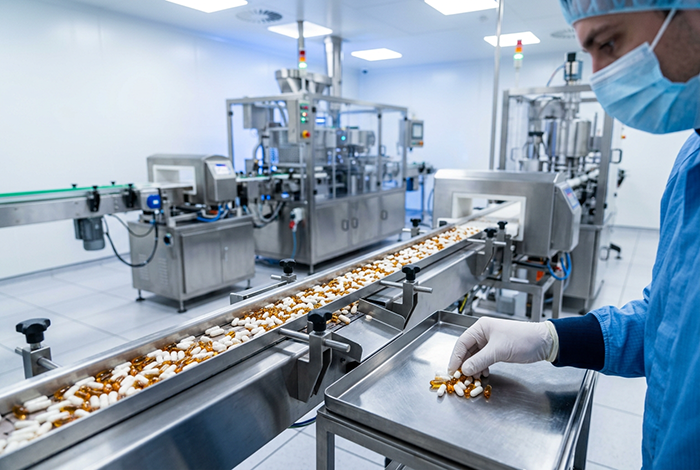
Phase 3 — Production and Packaging
Full-scale production follows the validated process:
- Weighing and dispensing — Precisely measuring ingredients per the master manufacturing record
- Blending/mixing — Homogenously combining ingredients to ensure uniform distribution
- Encapsulation/compression — Forming the dosage (filling capsules, compressing tablets, etc.)
- Coating (if applicable) — Applying enteric or aesthetic coatings to tablets
- Packaging — Bottling, blister packing, labeling, and cartoning
Phase 4 — Final Testing and Release
Before the product ships to you:
- Finished product testing — Full assay, microbial, and physical testing of the final batch
- Quality release — QA review of all documentation before product is released for sale
- Retain samples — Manufacturer retains samples for each batch for future reference and potential recall investigation
- Documentation package — Complete batch records, COA, and stability data delivered to the brand
Regulatory Compliance: Why cGMP (21 CFR 111) Is Non-Negotiable
Understanding cGMP Requirements for Dietary Supplements
In the United States, dietary supplement manufacturers must comply with Current Good Manufacturing Practices (cGMP) as defined in 21 CFR Part 111. This regulation establishes the minimum requirements for:
- Personnel — Qualified staff with proper training
- Facilities — Adequate space, sanitation, and environmental controls
- Equipment — Properly maintained, calibrated, and validated
- Production controls — Written procedures (SOPs), master manufacturing records, batch records
- Quality control — Testing of raw materials, in-process materials, and finished products
- Record keeping — Complete documentation of every batch for traceability
The Critical Importance of cGMP Compliance:
- It is a legal requirement for any dietary supplement sold in the US market
- It ensures product consistency — every batch meets the same quality standard
- It provides traceability — the ability to investigate and recall products if issues arise
- It protects your brand — non-compliant manufacturers expose you to FDA warning letters, recalls, and legal liability
Action Item: Never work with a supplement manufacturer that cannot demonstrate cGMP compliance. Request their cGMP certificate and, ideally, FDA establishment registration and audit history. This is the single most important qualification criterion.
Beyond cGMP — Additional Certifications That Matter
While cGMP is the baseline, leading manufacturers differentiate themselves with additional certifications:
| Certification | What It Signifies |
|---|---|
| NSF GMP Certification | Third-party verified cGMP compliance (US) |
| NSF Certified for Sport® | Testing for banned substances — critical for sports nutrition brands |
| USP Verified | Verification against USP quality standards |
| Organic Certification (USDA/EU) | Compliance with organic production standards |
| Non-GMO Project Verified | Non-GMO ingredient verification |
| Halal / Kosher | Religious dietary compliance for specific markets |
| ISO 22000 / FSSC 22000 | International food safety management standards |
| Informed Choice / Informed Sport | Banned substance screening for sports products |
The certifications you require depend on your target market and product positioning. A sports nutrition brand selling to athletes needs NSF Certified for Sport®; a clean-label brand targeting the natural channel needs organic and non-GMO certifications.
How to Choose a Supplement Contract Manufacturer: A Step-by-Step Framework
Step 1 — Define Your Requirements
Before contacting manufacturers, document your exact needs:
- Product type — Capsule, tablet, softgel, powder, gummy, liquid?
- Formulation — Do you have a proprietary formula, or do you need development support?
- Volume — Expected initial order and projected annual volume
- Budget — Per-unit cost targets and total project budget
- Target market — US, EU, Asia, or global (affects regulatory requirements)
- Timeline — Desired time-to-market
Step 2 — Shortlist and Vet Candidates
Build a shortlist of 3-5 manufacturers using these sources:
- Industry directories — NutraIngredients, Natural Products Insider supplier directories
- Trade shows — SupplySide, Vitafoods, Expo West/East
- Referrals — From other brand owners, formulators, or industry consultants
- Competitor research — Identify who manufactures products similar to yours
Step 3 — Audit Quality Systems and Certifications
For each shortlisted manufacturer, verify:
- cGMP certification (mandatory)
- FDA establishment registration
- Audit history — have they passed third-party audits (NSF, USP, etc.)?
- Warning letter history — check FDA's website for any enforcement actions
- Quality control lab capabilities — in-house testing vs. outsourced?
Step 4 — Request Samples and Pilot Batches
Never commit to a manufacturer without:
- Sample products — Request samples of existing products to assess quality
- Pilot batch — Commission a small pilot batch of YOUR product to validate the full process
- Third-party testing — Send the pilot batch to an independent lab (Eurofins, SGS) for verification
Step 5 — Negotiate Terms and Establish QA Agreements
Finalize the relationship with clear agreements covering:
- Quality Agreement — Documented quality responsibilities for both parties
- Supply Agreement — Pricing, minimum order quantities (MOQs), lead times, payment terms
- Confidentiality / IP protection — Protect your formula and proprietary information
- Change control — Process for approving any changes to formula, materials, or process
- Recall procedures — Defined responsibilities in case of a product recall
15 Questions to Ask Before Signing with a Supplement Manufacturer
Quality & Compliance Questions
- Are you cGMP certified, and can you provide your certificate and FDA registration number?
- Do you have any FDA warning letters or enforcement actions in your history?
- What third-party certifications do you hold (NSF, USP, organic, non-GMO, Halal, Kosher)?
- Do you perform in-house quality testing, or do you outsource to third-party labs?
- Can you provide COAs and third-party test results for your raw material suppliers?
Production & Capacity Questions
- What is your minimum order quantity (MOQ), and can you accommodate smaller pilot runs?
- What is your typical lead time from order placement to delivery?
- What dosage forms do you specialize in (capsules, tablets, gummies, powders, liquids)?
- Do you provide formulation development support, or do you require a finished formula?
- What is your annual production capacity, and do you have capacity for my growth projections?
Cost & Commercial Questions
- What is your per-unit pricing structure, and what factors affect it?
- What are your payment terms, and is there financing available for larger orders?
- Who owns the formula and intellectual property developed during the engagement?
- Do you offer warehousing and fulfillment services, or is delivery only?
- What happens if there's a quality issue — what is your recall procedure and liability policy?
Red Flags to Avoid When Selecting a Contract Manufacturer
Watch for these warning signs that indicate a manufacturer may not be a reliable partner:
- 🚩 No cGMP certification or unwilling to share it — This is a non-negotiable baseline; walk away immediately
- 🚩 History of FDA warning letters or recalls — Check the FDA enforcement database before committing
- 🚩 Vague or evasive answers about quality testing — They should be transparent about their QC processes
- 🚩 Unusually low pricing — Quality testing, documentation, and compliance all cost money; extremely low prices suggest corners are being cut
- 🚩 Inability to provide COAs or third-party test results — Every reputable manufacturer can provide batch documentation
- 🚩 Refusal to allow facility audits — A transparent manufacturer welcomes audits
- 🚩 High employee turnover or unstable leadership — Consistent quality requires stable, experienced staff
- 🚩 Pressure to sign quickly without a pilot batch — A quality manufacturer wants you to validate before committing
- 🚩 No clear recall or complaint handling procedure — You need defined responsibilities for worst-case scenarios
- 🚩 Lack of regulatory expertise — They should understand FDA, EFSA, and other relevant regulations for your target markets
Frequently Asked Questions (FAQ)
What is the difference between OEM, ODM, and private label supplement manufacturing?
OEM (Original Equipment Manufacturing) means you provide the complete formula and specifications, and the manufacturer produces it to your exact requirements — you own the formula. ODM (Original Design Manufacturing) means the manufacturer offers pre-developed formulas that you customize with branding. Private label / white label means you apply your label to the manufacturer's ready-made products with minimal customization. OEM offers the most control but highest cost; private label is fastest and cheapest but least differentiated.
How much does it cost to start a supplement line with a contract manufacturer?
Costs vary widely based on product type, formulation complexity, MOQ, and certification requirements. Typical initial costs include: formulation development (if needed), pilot batch fees, packaging design and materials, and the initial production run. For private label products, entry costs can be as low as a few thousand dollars; for custom OEM formulations, expect 50,000+ including development, testing, and initial inventory. Always request a detailed quote breakdown before committing.
What is the typical minimum order quantity (MOQ) for supplement manufacturing?
MOQs vary significantly by dosage form and manufacturer. Typical ranges: capsules and tablets — 1,000 to 10,000 units minimum; gummies — 10,000 to 50,000 units (due to mold costs); powders — 500 to 1,000 kg; liquids — 500 to 1,000 bottles. Some manufacturers offer lower MOQs for new brands at higher per-unit pricing. Clarify MOQs early, as they directly impact your initial capital requirements.
How long does it take to launch a supplement product?
Typical timelines: private label — 4-8 weeks (products already developed); ODM — 8-12 weeks (formula selection and minor customization); OEM with custom formula — 3-6 months (formula development, stability testing, validation, production). Factors affecting timeline include ingredient availability, testing requirements, packaging lead times, and regulatory review (if applicable).
What is cGMP and why is it important for supplement manufacturing?
cGMP (Current Good Manufacturing Practices) is a set of FDA regulations (21 CFR Part 111) that establish minimum quality standards for dietary supplement manufacturing. cGMP compliance ensures products are consistently produced to quality standards, are properly labeled, and are free of contamination. It is legally required for supplements sold in the US, and working with a cGMP-certified manufacturer is essential for regulatory compliance and brand protection.
Should I choose a US-based or overseas supplement manufacturer?
Both have trade-offs. US-based manufacturers offer easier communication, faster shipping, and clearer regulatory oversight but higher costs. Overseas manufacturers (particularly in China, India, and Eastern Europe) offer lower costs and access to ingredient supply chains but require more rigorous quality verification and longer lead times. Many brands use a hybrid approach — sourcing ingredients overseas and manufacturing domestically, or working with overseas manufacturers that have US warehousing and regulatory expertise. Whichever you choose, cGMP compliance and third-party testing are non-negotiable.
Can a contract manufacturer help with supplement formulation?
Yes — most full-service manufacturers offer formulation development support. They can help you determine appropriate dosages, select compatible excipients, ensure ingredient stability, and optimize the formulation for manufacturability. If you have a concept but not a specific formula, look for a manufacturer with an in-house R&D team and formulation expertise in your product category.
Conclusion
Choosing the right supplement contract manufacturer is one of the most consequential decisions you'll make as a supplement brand owner. The right partner provides more than production capacity — they contribute technical expertise, regulatory compliance, quality assurance, and the scalability to grow your brand. The wrong partner exposes you to regulatory risk, quality failures, and brand damage.
The framework is clear: define your requirements, vet candidates against cGMP and certification standards, commission pilot batches with independent testing, and establish clear quality and supply agreements. Never compromise on cGMP compliance, never skip third-party testing, and never rush past the pilot batch phase — these are the pillars of a successful manufacturing partnership.
At JHD CORP / IngredientsSupply, we combine premium ingredient sourcing with full-service OEM/ODM supplement manufacturing — offering cGMP/ISO-certified production, complete documentation support, and flexible order quantities to support brands from concept to commercial scale.
Contact us at sales@ingredientssupply.com to discuss your supplement manufacturing project and request a quote.