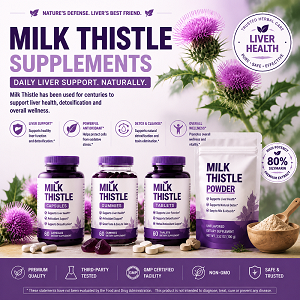
Milk Thistle Extract (Silymarin): The Complete B2B Supplier Guide for Liver Health Supplement Manufacturers
Liver health supplements represent one of the largest and most resilient categories in the global nutraceutical market, driven by rising consumer awareness of metabolic health, alcohol consumption patterns, and increasing exposure to environmental toxins. At the center of this category sits one botanical ingredient with centuries of traditional use and a substantial body of modern clinical research: milk thistle extract (Silymarin).
What Is Milk Thistle Extract? Understanding Silymarin and Its Active Compounds
Botanical Origin and Active Constituent Profile
Milk thistle (Silybum marianum (L.) Gaertn, family: Asteraceae) is a flowering plant native to the Mediterranean region, now cultivated globally for its medicinal seeds. The plant's therapeutic properties are concentrated in its seeds, from which a standardized extract — known as silymarin — is produced.
Silymarin is not a single compound but a complex mixture of flavonolignans, consisting of:
| Flavonolignan | Approximate % of Silymarin Complex | Biological Activity |
|---|---|---|
| Silybin (Silymarin I) | 50-60% | Most abundant and most biologically active; exists as two diastereomers (Silybin A and Silybin B) |
| Isosilybin (Silymarin II) | 5-10% | Structural isomer of silybin; contributes to antioxidant activity |
| Silydianin | 5-10% | Unique flavonolignan; less studied but contributes to total activity |
| Silychristin | 15-25% | Second most abundant; contributes to hepatoprotective effects |
Additionally, milk thistle seeds contain taxifolin (a flavonoid precursor) and approximately 20-30% fatty oil rich in linoleic acid.
Key Data:
- Latin name: Silybum marianum (L.) Gaertn
- Plant part used: Dried ripe seeds (fruits)
- CAS Number: 65666-07-1 (silymarin)
- Appearance: Light yellow to yellow-brown fine powder
- Taste: Characteristic, slightly bitter
Silymarin vs. Silybin — Why This Distinction Matters for Product Labeling
One of the most common points of confusion in milk thistle sourcing is the distinction between "silymarin" and "silybin":
| Parameter | Silymarin (Total) | Silybin + Isosilybin |
|---|---|---|
| Definition | Total flavonolignan complex | Sum of the two most active isomers |
| Standard Specification | ≥80% (by UV spectrophotometry) | ≥30% (by HPLC) |
| Testing Method | UV-Vis (measures all flavonolignans as a group) | HPLC (separates and quantifies individual isomers) |
| Labeling Implication | "Milk Thistle Extract (80% Silymarin)" | "Milk Thistle Extract (standardized to 30% Silybin + Isosilybin)" |
| Regulatory Preference | Widely accepted globally (USP, EP) | Increasingly preferred for premium products (provides isomer-specific standardization) |
Formulation Insight: The industry gold standard is a dual-specification extract: Silymarin ≥80% (UV) AND Silybin + Isosilybin ≥30% (HPLC). This dual standardization provides assurance of both total flavonolignan content and the presence of the most biologically active isomers. When sourcing, always request both UV and HPLC data on the COA.
The Science of Silymarin — Key Clinical Evidence for Supplement Formulators
Mechanisms of Hepatoprotective Action
Silymarin exerts its liver-protective effects through multiple well-characterized mechanisms:
-
Antioxidant Activity: Silymarin is a potent free radical scavenger that increases intracellular glutathione (GSH) levels in hepatocytes — the liver's primary endogenous antioxidant defense system (Vargas-Mendoza et al., 2014).
-
Anti-inflammatory Action: Silymarin inhibits NF-κB activation, reducing the expression of pro-inflammatory cytokines including TNF-α, IL-1β, and IL-6 — key mediators of hepatic inflammation.
-
Anti-fibrotic Effects: Research demonstrates that silymarin downregulates TGF-β signaling pathways and inhibits hepatic stellate cell activation, the primary drivers of liver fibrosis (Trappoliere et al., 2009).
-
Membrane Stabilization: Silymarin interacts with hepatocyte cell membranes, reducing the entry of hepatotoxins and stabilizing membrane integrity against oxidative damage.
-
Enhanced Protein Synthesis: Silymarin stimulates RNA polymerase I activity in hepatocytes, promoting ribosomal RNA synthesis and cellular regeneration — a mechanism particularly relevant to recovery from liver injury.
-
Metabolic Regulation: Emerging evidence (PMID: 27340676) suggests silymarin improves insulin sensitivity and glycemic control, broadening its application beyond classical liver health.
Clinical Data and Meta-Analysis Highlights
A comprehensive narrative review published in Food Science & Nutrition (2024, PMID: 38726410) examined the full pharmacological spectrum of silymarin in liver diseases and concluded that silymarin demonstrates clinically meaningful hepatoprotective effects, particularly in:
- Non-alcoholic fatty liver disease (NAFLD): Multiple RCTs have shown silymarin supplementation (typically 420-600 mg/day, standardized to 70-80% silymarin) significantly reduces ALT and AST levels and improves liver histology scores compared to placebo
- Alcoholic liver disease: A clinical trial of 60 adults with alcoholic liver cirrhosis found that 450 mg/day of milk thistle extract improved liver function markers and reduced fibrosis indicators
- Drug-induced liver injury: Silymarin has demonstrated protective effects against hepatotoxicity induced by medications including acetaminophen, antituberculosis drugs, and chemotherapy agents
- Metabolic-associated liver conditions: A 2024 narrative review in ResearchGate confirmed silymarin's beneficial effects on liver health across multiple etiologies
Compliance Note for Product Marketing: Characterize milk thistle extract as "supports healthy liver function," "promotes liver detoxification processes," and "helps maintain healthy liver enzyme levels" — NOT as treating, curing, or preventing specific liver diseases. All product claims must comply with FDA 21 CFR 101.93 and EFSA health claim regulations.
Market Applications — Where Milk Thistle Extract Fits in Supplement Product Lines
Liver Health and Detox Formulations
The liver health supplement category is projected to account for 38.9% of the global milk thistle market (Coherent Market Insights, 2026), making this the primary application for B2B supplement manufacturers. Common product formats include:
- Standalone Milk Thistle Capsules/Tablets: Typically 250-500 mg per capsule of 80% silymarin extract, providing 200-400 mg silymarin per serving
- Liver Detox Complex Formulas: Milk thistle combined with N-Acetyl Cysteine (NAC), artichoke extract, dandelion root, and alpha-lipoic acid
- Post-Celebration / Hangover Support: Milk thistle with electrolytes, B vitamins, and prickly pear extract — a popular seasonal product category
- Daily Liver Maintenance: Lower-dose formulations (150-250 mg silymarin/day) for long-term liver health support
Combination Products and Emerging Applications
Milk thistle's versatility extends beyond pure liver health:
- Metabolic Health Blends: Milk thistle + berberine + chromium (targeting blood sugar management and metabolic syndrome)
- Skin Health / Anti-Acne: Emerging category — silymarin's anti-inflammatory and antioxidant properties are being explored for hormonal acne and skin clarity supplements
- Sports Recovery: Milk thistle incorporated into post-workout recovery formulas targeting exercise-induced oxidative stress
- Vegan/Plant-Based Liver Support: Growing demand for plant-derived liver health solutions as alternatives to animal-derived products
Quality Specifications — What to Look for When Sourcing Bulk Milk Thistle Extract
Standardization: The Industry Gold Standard
The most widely recognized quality standard for milk thistle extract is the dual specification:
| Specification | Standard Value | Testing Method |
|---|---|---|
| Total Silymarin | ≥80.0% | UV Spectrophotometry (λ = 288 nm, using silymarin as reference standard) |
| Silybin + Isosilybin | ≥30.0% | HPLC (isomer-specific quantification) |
Why Dual Specification Matters: UV spectrophotometry measures total flavonolignans as a group but cannot distinguish individual isomers. Since silybin is the most biologically active component, HPLC quantification ensures that the extract contains adequate levels of the active isomers — not just total flavonolignans that may be disproportionately composed of less active constituents.
Complete Quality Parameter Table
When evaluating bulk milk thistle extract, verify these parameters on the COA:
| Parameter | Specification | Test Method |
|---|---|---|
| Silymarin (Total) | ≥80.0% | UV at 288 nm |
| Silybin + Isosilybin | ≥30.0% | HPLC |
| Silydianin + Silychristin | Report value | HPLC |
| Appearance | Light yellow to yellow-brown fine powder | Visual |
| Odor & Taste | Characteristic | Organoleptic |
| Particle Size | 95% through 80 mesh | Sieve analysis |
| Loss on Drying | ≤5.0% | USP <731> |
| Ash Content | ≤5.0% | USP <281> |
| Heavy Metals (as Pb) | ≤10 ppm | ICP-MS |
| Lead (Pb) | ≤1.0 ppm | ICP-MS |
| Arsenic (As) | ≤1.0 ppm | ICP-MS |
| Cadmium (Cd) | ≤0.5 ppm | ICP-MS |
| Mercury (Hg) | ≤0.1 ppm | ICP-MS |
| Total Plate Count | ≤1,000 CFU/g | USP <2021> |
| Yeast & Mold | ≤100 CFU/g | USP <2021> |
| E. coli | Negative / 10g | USP <2022> |
| Salmonella | Negative / 25g | USP <2022> |
| Staphylococcus aureus | Negative / 10g | USP <2022> |
| Residual Solvents | Complies with USP <467> | GC |
| Pesticide Residues | Complies with USP <561> | GC-MS / LC-MS |
Extraction Methods — Ethanol vs. Acetone vs. Ethyl Acetate
The extraction method significantly affects the quality, purity, and regulatory acceptability of milk thistle extract:
| Method | Solvent | Pros | Cons | Suitability |
|---|---|---|---|---|
| Ethanol Extraction | Ethanol (food-grade) | Clean-label friendly, low toxicity solvent, acceptable globally | Slightly lower yield of individual isomers | ✓ Premium / Organic / EU-focused products |
| Ethyl Acetate Extraction | Ethyl acetate | High silybin yield, efficient cost profile | Requires thorough solvent removal verification | ✓ Standard commercial grade |
| Acetone Extraction | Acetone | Highest silymarin yield, lowest cost | Solvent residue concerns; some markets restrict acetone-extracted ingredients | ⚠️ Cost-sensitive products; verify solvent residue compliance |
B2B Recommendation: For premium supplement brands targeting EU and North American markets, specify ethanol-extracted or ethyl acetate-extracted milk thistle extract with verified residual solvent compliance. Always request residual solvent analysis on the COA, regardless of the claimed extraction method.
How to Evaluate and Select a Milk Thistle Extract Supplier
Supplier Qualification Checklist
Use this checklist when evaluating potential bulk milk thistle extract suppliers:
☐ Manufacturing Certifications — cGMP, ISO 9001, ISO 22000, or FSSC 22000 ☐ Dual Specification Capability — Can provide both UV (silymarin ≥80%) and HPLC (Silybin+Isosilybin ≥30%) data ☐ Extraction Method Disclosure — Transparent about solvent used (ethanol, ethyl acetate, or acetone) ☐ Third-Party Testing — Eurofins, SGS, or equivalent independent lab reports available ☐ Batch-to-Batch Consistency — COAs from last 3-5 production batches showing stable silymarin and silybin levels ☐ Stability Data — Accelerated and real-time stability study results (24-36 months) ☐ Supply Chain Traceability — Country of origin for raw seeds; sustainable harvesting practices ☐ Production Capacity — Can meet your annual volume requirements with safety stock ☐ Logistics & Warehousing — US/EU warehousing capabilities; DDP and DAP shipping options ☐ Technical Support — Formulation guidance, solubility data, compatibility testing, regulatory documentation
Documentation Requirements
Before finalizing a supplier relationship, request:
- Certificate of Analysis (COA) — Current batch, showing full specification compliance including both UV and HPLC data
- Material Safety Data Sheet (MSDS/SDS)
- Flow Chart / Manufacturing Process Description — Including extraction solvent details
- Stability Study Report — Real-time and accelerated conditions
- Allergen Statement — Milk thistle is generally non-allergenic, but verify cross-contamination controls
- GMO Statement — Non-GMO confirmation
- BSE/TSE Statement
- Residual Solvent Analysis — Critical for verifying extraction solvent compliance
- Third-Party Laboratory Test Report — Independent verification of purity and potency
- Heavy Metal Testing Report — Full panel (Pb, As, Cd, Hg)
Red Flags and Common Quality Issues
- 🚩 COA shows silymarin ≥80% but no HPLC data for silybin + isosilybin (may indicate silymarin padding with less active flavonolignans)
- 🚩 Supplier cannot or will not disclose extraction solvent
- 🚩 Inconsistent color or particle size across batches (may indicate blending of different quality grades)
- 🚩 Solvent odor in powder (incomplete solvent removal — a GMP violation)
- 🚩 Pricing significantly below market average (possible adulteration with cheaper botanical powders)
- 🚩 No third-party testing capability or unwillingness to accept customer-nominated lab testing
- 🚩 Only provides UV silymarin data without HPLC isomer breakdown
Frequently Asked Questions (FAQ)
What is the difference between silymarin 70%, 80%, and 90% milk thistle extract?
These percentages refer to the total silymarin content measured by UV spectrophotometry. 80% silymarin is the industry standard and most widely used in dietary supplements. Silymarin 70% is considered a lower-grade product typically used in cost-sensitive formulations. Silymarin 90%+ is available but commands a significant price premium and is not necessarily more effective — the isomer profile (silybin content) matters more than a higher UV number alone.
What dosage of milk thistle extract is standard for supplements?
Clinical studies have most commonly used 420-600 mg/day of milk thistle extract (standardized to 70-80% silymarin), typically divided into 2-3 doses. This provides approximately 300-480 mg of silymarin per day. The most common supplement format is a 250-500 mg capsule of 80% silymarin extract, delivering 200-400 mg silymarin per serving.
Does milk thistle extract require special handling during manufacturing?
Milk thistle extract is a moderately hygroscopic powder that should be stored in sealed containers at 15-25°C, protected from light and moisture. It has acceptable flow characteristics for capsule filling and tablet compression. Its yellow-brown color may affect the appearance of light-colored formulations — consider opaque capsules or colored coatings. Silymarin is relatively heat-stable but sensitive to prolonged exposure to high humidity.
Is milk thistle extract suitable for vegan products?
Yes. Milk thistle extract is plant-derived and inherently vegan. However, verify: (a) capsule shell material if purchasing finished capsules; (b) that processing aids and excipients used in extraction and standardization are also vegan-compatible; (c) request a vegan statement from the supplier.
What is the typical MOQ for bulk milk thistle extract?
Standard B2B MOQs range from 1 kg (sample/trial orders) to 25 kg (standard commercial order). Larger volumes (100 kg, 500 kg+) provide significant price advantages. Milk thistle seeds have a relatively stable supply chain with major production in China, Eastern Europe, and South America — supply disruption risk is generally low.
How should I label milk thistle extract on my supplement facts panel?
Standard labeling options include: "Milk Thistle Seed Extract (Silybum marianum) (standardized to 80% Silymarin)" or "Milk Thistle Extract (providing XX mg Silymarin)." For premium products, some brands also declare the silybin level: "Milk Thistle Extract (standardized to contain 80% Silymarin and 30% Silybin + Isosilybin)." Always verify label claim compliance with the regulatory authority in your target market (FDA, EFSA, TGA, Health Canada).
What is the shelf life of milk thistle extract powder?
When stored in sealed, original packaging under recommended conditions (cool, dry, 15-25°C, protected from light), typical shelf life is 24-36 months from the date of manufacture. Stability studies should confirm silymarin content remains ≥80% of the labeled value throughout the claimed shelf life.
Conclusion
Milk thistle extract (silymarin) represents a foundational botanical ingredient for any supplement manufacturer operating in the liver health space — a category that continues to expand as consumers increasingly prioritize metabolic wellness, detoxification support, and proactive liver care.
For B2B buyers, the critical differentiator in milk thistle sourcing is not just the silymarin percentage on the label, but the completeness of quality documentation: dual UV + HPLC specification data, extraction solvent transparency, residual solvent testing, and third-party laboratory verification. The industry gold standard — Silymarin ≥80% (UV) with Silybin + Isosilybin ≥30% (HPLC) — provides the most reliable quality benchmark for supplement formulation.
At JHD CORP / IngredientsSupply, we supply premium-grade milk thistle extract to global nutraceutical manufacturers, with full dual-specification COA documentation, third-party testing via Eurofins and SGS, and flexible order quantities to support both product development and commercial-scale manufacturing.
Contact us at sales@ingredientssupply.com to request a specification sheet, COA, or product sample for your liver health formulation project.